Representative Values of Hydraulic Properties
by Glenn M. Duffield, President, HydroSOLVE, Inc.
Aquifer tests (pumping tests, slug tests and constant-head tests) are performed to estimate site-specific values for the hydraulic properties of aquifers and aquitards. Under certain circumstances, however, site-specific hydraulic property data may not be available when needed. For example, reconnaissance studies or scoping calculations may require hydraulic property values before on-site investigations are performed.
The following sections present representative hydraulic property values reported in the literature for horizontal and vertical hydraulic conductivity, storativity, specific yield and porosity. Refer to these values if site-specific data are unavailable for your study or to check the results of field and laboratory tests conducted at an investigation site.
 Try out the interactive calculators for estimating hydraulic conductivity from grain size, specific storage and storativity!
Hydraulic
Conductivity (K)
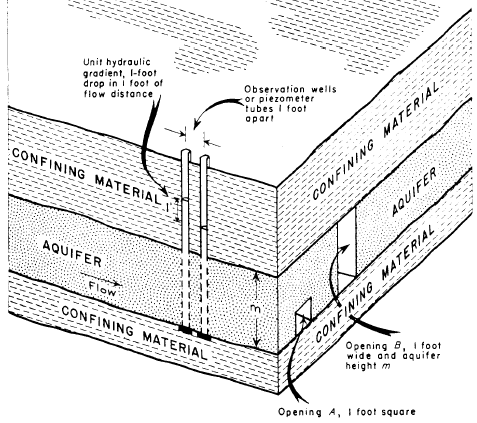
Hydraulic conductivity is a measure of a material's capacity to transmit water. It is defined as a constant of proportionality relating the specific discharge of a porous medium under a unit hydraulic gradient in Darcy's law:
where is specific discharge [L/T], is hydraulic conductivity [L/T] and is hydraulic gradient [dimensionless]. Coefficient of permeability is another term for hydraulic conductivity.
Note that hydraulic conductivity, which is a function of water viscosity and density, is in a strict sense a function of water temperature; however, given the small range of temperature variation encountered in most groundwater systems, the temperature dependence of hydraulic conductivity is often neglected.
Transmissivity is the rate of flow under a unit hydraulic gradient through a unit width of aquifer of given saturated thickness. The transmissivity of an aquifer is related to its hydraulic conductivity as follows:
where is transmissivity [L2/T] and is aquifer thickness [L].
Representative Values
The following tables show representative values of hydraulic conductivity for various unconsolidated sedimentary materials, sedimentary rocks and crystalline rocks (from Domenico and Schwartz 1990):
| Unconsolidated Sedimentary Materials | |
| Material | Hydraulic Conductivity (m/sec) |
| Gravel | 3×10⁻⁴ to 3×10⁻² |
| Coarse sand | 9×10⁻⁷ to 6×10⁻³ |
| Medium sand | 9×10⁻⁷ to 5×10⁻⁴ |
| Fine sand | 2×10⁻⁷ to 2×10⁻⁴ |
| Silt, loess | 1×10⁻⁹ to 2×10⁻⁵ |
| Till | 1×10-12 to 2×10⁻⁶ |
| Clay | 1×10-11 to 4.7×10⁻⁹ |
| Unweathered marine clay | 8×10-13 to 2×10⁻⁹ |
| Sedimentary Rocks | |
| Rock Type | Hydraulic Conductivity (m/sec) |
| Karst and reef limestone | 1×10⁻⁶ to 2×10⁻² |
| Limestone, dolomite | 1×10⁻⁹ to 6×10⁻⁶ |
| Sandstone | 3×10⁻¹⁰ to 6×10⁻⁶ |
| Siltstone | 1×10-11 to 1.4×10⁻⁸ |
| Salt | 1×10-12 to 1×10⁻¹⁰ |
| Anhydrite | 4×10-13 to 2×10⁻⁸ |
| Shale | 1×10-13 to 2×10⁻⁹ |
| Crystalline Rocks | |
| Material | Hydraulic Conductivity (m/sec) |
| Permeable basalt | 4×10⁻⁷ to 2×10⁻² |
| Fractured igneous and metamorphic rock | 8×10⁻⁹ to 3×10⁻⁴ |
| Weathered granite | 3.3×10⁻⁶ to 5.2×10⁻⁵ |
| Weathered gabbro | 5.5×10⁻⁷ to 3.8×10⁻⁶ |
| Basalt | 2×10-11 to 4.2×10⁻⁷ |
| Unfractured igneous and metamorphic rock | 3×10-14 to 2×10⁻¹⁰ |
| To Convert | Multiply By | To Obtain |
| m/sec | 100 | cm/sec |
| m/sec | 2.12×10⁶ | gal/day/ft2 |
| m/sec | 3.2808 | ft/sec |
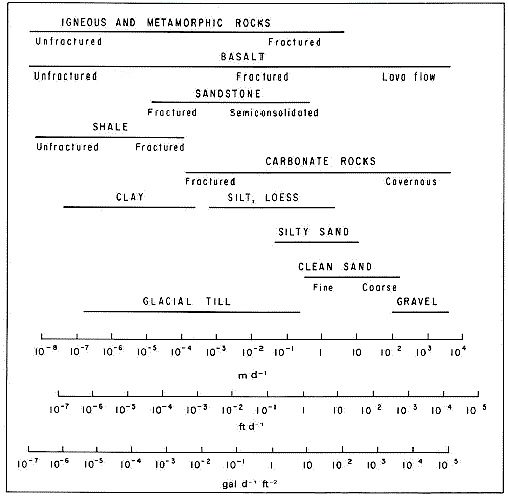
Grain Size Relationships
A number of empirical formulas, some dating back over a century, have been proposed which attempt to relate the hydraulic conductivity of an unconsolidated geologic material (granular sediment or soil) to its grain size distribution obtained from sieve analysis. While these formulas can be useful as a first approximation of , one should bear in mind that their generality is limited by a number of factors including the following:
- the number of sediment samples used to develop the formula
- the geologic environment(s) comprising the samples used to develop the formula
- the range of grain size assumed for the formula
- the uniformity of grain size assumed for the formula
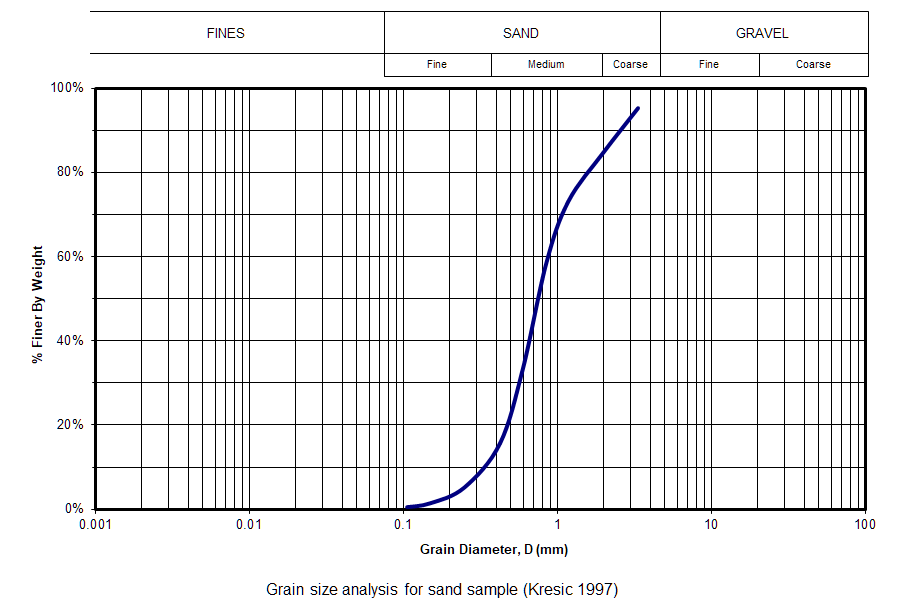
Equations for estimating from grain size commonly use two metrics from a grain size distribution plot: , the grain diameter for which 10% of the sample is finer (90% is coarser), and , the grain diameter for which 60% of the sample is finer (40% is coarser). is frequently taken as the effective diameter of the sample while the ratio = / is known as the coefficient of uniformity.
The following calculator uses formulas by Hazen, Kozeny-Carmen, Beyer and Wang et al. to estimate from grain size and porosity data.
Hazen Formula
Hazen (1892; 1911) developed a simple formula for estimating the hydraulic conductivity of a saturated sand from its grain size distribution:
where is hydraulic conductivity [cm/s], is an empirical coefficient equal to 100 cm‑1s‑1 and is measured in cm.
As reported by Carrier (2003), is most commonly given as 100 but published values range over two orders of magnitude from 1 to 1000 cm‑1s‑1. The Hazen formula is assumed valid for 0.1 mm ≤ ≤ 3 mm and ≤ 5 (Kresic 1997).
Kozeny-Carmen Formula
An equation attributed to Kozeny and Carmen (Freeze and Cherry 1979; Rosas et al. 2014) may be used to estimate the hydraulic conductivity of sediments and soils:
where is hydraulic conductivity [m/s], is an empirical coefficient equal to 1/180 [dimensionless], is gravitational acceleration [m/s²], is kinematic viscosity of water [m²/s] and is total porosity [dimensionless]. is measured in m.
The Kozeny-Carmen formula is assumed valid for sediments and soils composed of silt, sand and gravelly sand (Rosas et al. 2014).
Beyer Formula
Beyer (1964) also proposed a simple relationship for estimating hydraulic conductivity from a sediment's grain size distribution:
where is hydraulic conductivity [m/s], is an empirical coefficient equal to 6×10⁻⁴ [dimensionless], is gravitational acceleration [m/s²] and is kinematic viscosity of water [m²/s]. and are measured in m.
The Beyer formula is assumed valid for 0.06 mm ≤ ≤ 0.6 mm and 1 ≤ ≤ 20 (Kresic 1997).
Wang Et Al. Formula
Wang et al. (2017) developed another empirical formula for estimating hydraulic conductivity from the grain size distribution of a sediment or soil:
where is hydraulic conductivity [m/s], is an empirical coefficient equal to 2.9×10⁻³ [dimensionless], is gravitational acceleration [m/s²] and is kinematic viscosity of water [m²/s]. and are measured in m.
The Wang et al. formula is developed from a dataset (Rosas et al. 2014) characterized by 0.05 mm ≤ ≤ 0.83 mm, 0.09 mm ≤ ≤ 4.29 mm and 1.3 ≤ ≤ 18.3.
Hydraulic Conductivity Anisotropy Ratio (Kz/Kr)
An anisotropy ratio relates hydraulic conductivities in different directions. For example, vertical-to-horizontal hydraulic conductivity anisotropy ratio is given by where is vertical hydraulic conductivity [L/T] and is radial (horizontal) hydraulic conductivity [L/T]. Anisotropy in a horizontal plane is given by where and are horizontal hydraulic conductivities in the and directions, respectively [L/T].
Todd (1980) reports values of ranging between 0.1 and 0.5 for alluvium and possibly as low as 0.01 when clay layers are present.
Representative Values
The following table shows representative values of horizontal and vertical hydraulic conductivities for selected rock types (from Domenico and Schwartz 1990):
| Material | Horizontal Hydraulic Conductivity (m/sec) |
Vertical Hydraulic Conductivity (m/sec) |
| Anhydrite | 10-14 to 10-12 | 10-15 to 10-13 |
| Chalk | 10-10 to 10-8 | 5×10-11 to 5×10⁻⁹ |
| Limestone, dolomite |
10-9 to 10-7 | 5×10⁻¹⁰ to 5×10⁻⁸ |
| Sandstone | 5×10-13 to 10-10 | 2.5×10⁻¹³ to 5×10-11 |
| Shale | 10-14 to 10-12 | 10-15 to 10-13 |
| Salt | 10-14 | 10-14 |
Storativity (S)
Confined Aquifers
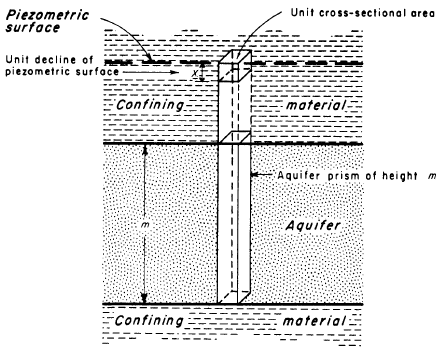
The storativity of a confined aquifer (or aquitard) is defined as the volume of water released from storage per unit surface area of the aquifer or aquitard per unit decline in hydraulic head. Storativity is also known by the terms coefficient of storage and storage coefficient.
Pumping a well in a confined aquifer releases water from aquifer storage by two mechanisms: compression of the aquifer and expansion of water.
In a confined aquifer (or aquitard), storativity is defined as
where is storativity [dimensionless], is specific storage [L-1] and is aquifer (or aquitard) thickness [L].
The typical storativity of a confined aquifer, which varies with specific storage and aquifer thickness, ranges from 5×10⁻⁵ to 5×10⁻³ (Todd 1980).
Specific storage is the volume of water that a unit volume of aquifer (or aquitard) releases from storage under a unit decline in head. Specific storage is related to the compressibilities of water and the aquifer (or aquitard) as follows:
where is mass density of water (= 1000 kg/m³) [M/L³], is gravitational acceleration (= 9.8 m/sec²) [L/T²], is aquifer (or aquitard) compressibility [T²L/M], is total porosity [dimensionless], and is compressibility of water (= 4.4×10⁻¹⁰ m sec²/kg or Pa-1) [T²L/M].
Unconfined Aquifers
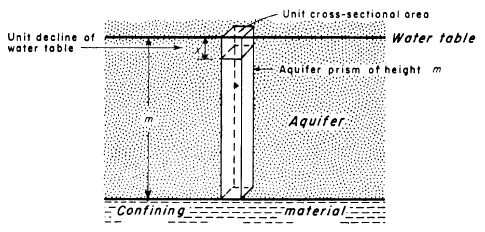
The storativity of an unconfined aquifer includes its specific yield or drainable porosity:
where is specific yield [dimensionless].
Lowering of the water table in an unconfined aquifer leads to the release of water stored in interstitial openings by gravity drainage.
Compared to gravity drainage, aquifer compression and water expansion in a water-table aquifer yield relatively little water from storage; hence, and in unconfined aquifers.
Storativity in unconfined aquifers typically ranges from 0.1 to 0.3 (Lohman 1972).
Representative Values
The following table provides representative values of specific storage for various geologic materials (Domenico and Mifflin [1965] as reported in Batu [1998]):
| Material | Ss (ft-1) |
| Plastic clay | 7.8×10⁻⁴ to 6.2×10⁻³ |
| Stiff clay | 3.9×10⁻⁴ to 7.8×10⁻⁴ |
| Medium hard clay | 2.8×10⁻⁴ to 3.9×10⁻⁴ |
| Loose sand | 1.5×10⁻⁴ to 3.1×10⁻⁴ |
| Dense sand | 3.9×10⁻⁵ to 6.2×10⁻⁵ |
| Dense sandy gravel | 1.5×10⁻⁵ to 3.1×10⁻⁵ |
| Rock, fissured | 1×10⁻⁶ to 2.1×10⁻⁵ |
| Rock, sound | < 1×10⁻⁶ |
| To Convert | Divide By | To Obtain |
| ft-1 | 0.3048 | m-1 |
Freeze and Cherry (1979) provided the following compressibility values for various aquifer materials:
| Material | Compressibility, α (m2/N or Pa-1) |
| Clay | 10-8 to 10-6 |
| Sand | 10-9 to 10-7 |
| Gravel | 10-10 to 10-8 |
| Jointed rock | 10-10 to 10-8 |
| Sound rock | 10-11 to 10-9 |
Pa-1 = m2/N = m sec2/kg
- Use compressibility data to estimate the storativity of a 35-ft thick confined sand aquifer (assume = 1000 kg/m3 and = 0.3).
= (1000 kg/m3)(9.8 m/sec2) [10-8 m2/N + (0.3) (4.4×10⁻¹⁰ m2/N)](35 ft)(0.3048 m/ft) = 1.1×10⁻³
How much does the expansion of water contribute to the total storativity in this example?
= (1000 kg/m3)(9.8 m/sec2)(0.3)(4.4×10-10 m2/N)(35 ft)(0.3048 m/ft) = 1.4×10⁻⁵
- Use specific storage data to estimate storativity for the same confined sand aquifer given in the preceding example.
= (5×10⁻⁵ ft-1)(35 ft) = 1.8×10⁻³
Specific Storage Calculator
Enter values for aquifer compressibility and porosity to compute specific storage.
Storativity Calculator
Enter values for aquifer compressibility, porosity and thickness to compute storativity.
Specific Yield (Sy)
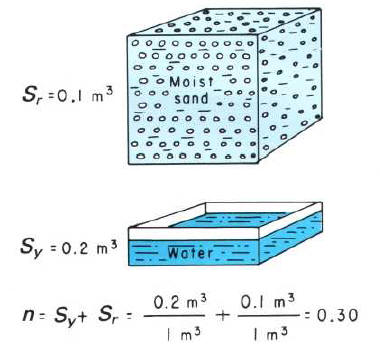
Specific yield is defined as the volume of water released from storage by an unconfined aquifer per unit surface area of aquifer per unit decline of the water table.
Bear (1979) relates specific yield to total porosity as follows:
where is total porosity [dimensionless], is specific yield [dimensionless] and is specific retention [dimensionless], the amount of water retained by capillary forces during gravity drainage of an unconfined aquifer. Thus, specific yield, which is sometimes called effective porosity, is less than the total porosity of an unconfined aquifer (Bear 1979).
Representative Values
Heath (1983) reports the following values (in percent by volume) for porosity, specific yield and specific retention:
| Material | Porosity (%) | Specific Yield (%) |
Specific Retention (%) |
| Soil | 55 | 40 | 15 |
| Clay | 50 | 2 | 48 |
| Sand | 25 | 22 | 3 |
| Gravel | 20 | 19 | 1 |
| Limestone | 20 | 18 | 2 |
| Sandstone (unconsolidated) | 11 | 6 | 5 |
| Granite | 0.1 | 0.09 | 0.01 |
| Basalt (young) | 11 | 8 | 3 |
The following table shows representative values of specific yield for various geologic materials (from Morris and Johnson 1967):
| Material | Specific Yield (%) |
| Gravel, coarse | 21 |
| Gravel, medium | 24 |
| Gravel, fine | 28 |
| Sand, coarse | 30 |
| Sand, medium | 32 |
| Sand, fine | 33 |
| Silt | 20 |
| Clay | 6 |
| Sandstone, fine grained | 21 |
| Sandstone, medium grained | 27 |
| Limestone | 14 |
| Dune sand | 38 |
| Loess | 18 |
| Peat | 44 |
| Schist | 26 |
| Siltstone | 12 |
| Till, predominantly silt | 6 |
| Till, predominantly sand | 16 |
| Till, predominantly gravel | 16 |
| Tuff | 21 |
Porosity (n)
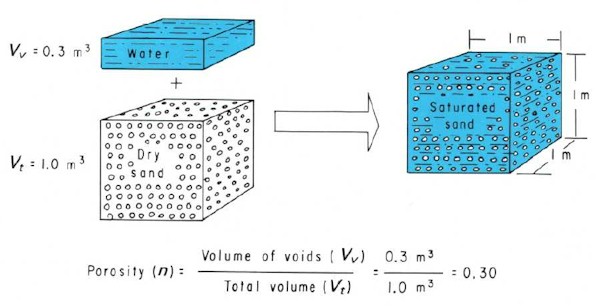
Porosity is defined as the void space of a rock or unconsolidated material:
where is porosity [dimensionless], is void volume [L3] and is total volume [L3].
Representative Values
The following tables show representative porosity values for various unconsolidated sedimentary materials, sedimentary rocks and crystalline rocks (from Morris and Johnson 1967):
| Unconsolidated Sedimentary Materials | |
| Material | Porosity (%) |
| Gravel, coarse | 24 - 37 |
| Gravel, medium | 24 - 44 |
| Gravel, fine | 25 - 39 |
| Sand, coarse | 31 - 46 |
| Sand, medium | 29 - 49 |
| Sand, fine | 26 - 53 |
| Silt | 34 - 61 |
| Clay | 34 - 57 |
| Sedimentary Rocks | |
| Rock Type | Porosity (%) |
| Sandstone | 14 - 49 |
| Siltstone | 21 - 41 |
| Claystone | 41 - 45 |
| Shale | 1 - 10 |
| Limestone | 7 - 56 |
| Dolomite | 19 - 33 |
| Crystalline Rocks | |
| Rock Type | Porosity (%) |
| Basalt | 3 - 35 |
| Weathered granite | 34 - 57 |
| Weathered gabbro | 42 - 45 |
See also: Argonne National Laboratory, Wolff (1982)