Slug Tests
by Glenn M. Duffield, President, HydroSOLVE, Inc.
What Is A
Slug Test?
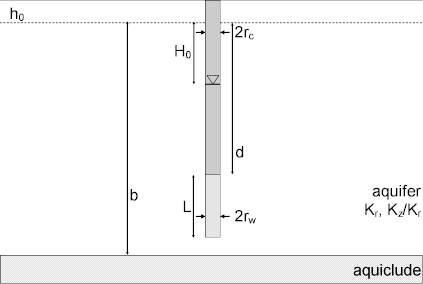
A slug test is a controlled field experiment performed by groundwater hydrologists to estimate the hydraulic properties of aquifers and aquitards in which the water level in a control well is caused to change suddenly (rise or fall) and the subsequent water-level response (displacement or change from static) is measured through time in the control well and one or more surrounding observation wells. Slug tests are frequently designated as rising-head or falling-head tests to describe the direction of water-level recovery in the control well following test initiation. Other terms sometimes used instead of slug test include baildown test, slug-in test and slug-out test.
The goal of a slug test, as in any aquifer test, is to estimate hydraulic properties of an aquifer system such as hydraulic conductivity.
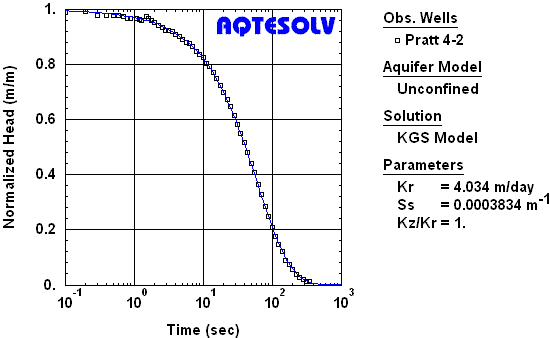
Aquifer properties are estimated from a slug test by fitting mathematical models to displacement data using a procedure known as curve matching. Curve matching may involve fitting type curves (Figure 2) or straight lines to the response data.
Attempting to match straight-line methods (e.g., Bouwer and Rice 1976) to slug test data with curvature leads to ambiguity. Reduce uncertainty by applying recommended normalized head ranges.
Besides slug tests, other types of aquifer tests used to determine aquifer properties include pumping tests and constant-head tests.
Learn more about the following slug test topics:
Types Of
Slug Tests
Rising-Head And Falling-Head Tests
Slug tests are often classified as either rising-head or falling-head tests depending on the direction of water-level recovery in the control well.
- A rising-head test is initiated by rapidly lowering the water level in the control well and then taking measurements of the rising water level in the well. Baildown test and slug-out test are alternate terms for rising-head test.
- A falling-head test is conducted by rapidly raising the water level in the control well and subsequently measuring the falling water level. Slug-in test is another term for falling-head test.
Overdamped And Underdamped Tests
The response measured during a slug test may be described as either overdamped or underdamped. Overdamped response occurs in aquifers of low to moderate hydraulic conductivity (K) while underdamped response may be observed in high-K aquifers.
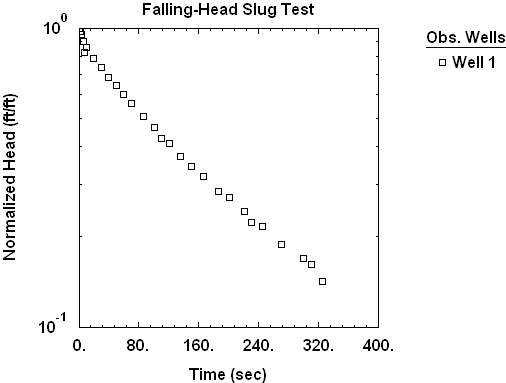
Overdamped response (Figure 3) is encountered most often in slug tests and is analyzed using mathematical models by Bouwer and Rice (1976), Hvorslev (1951) and Cooper et al. (1967) among others.
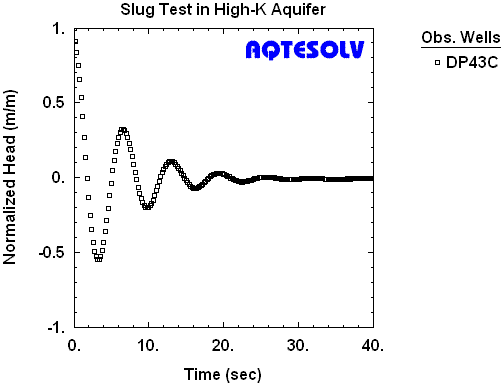
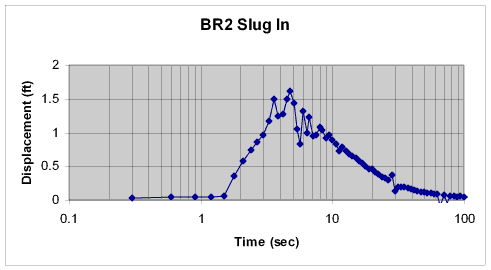
Underdamped response may occur in aquifers of high hydraulic conductivity. In an underdamped test, the response is oscillatory (Figure 4) and requires specialized methods for analysis, e.g., Springer and Gelhar (1991).
Wells Screened Across Water Table
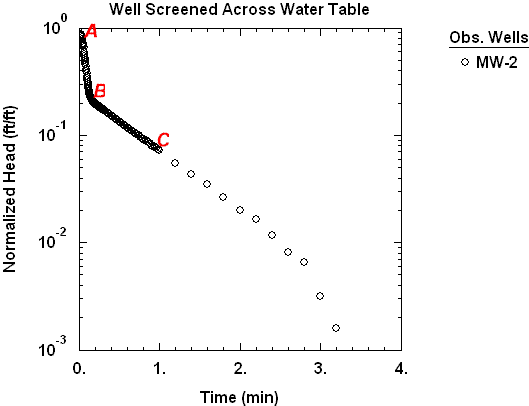
Slug tests conducted in wells screened across the water table may exhibit a phenomenon known as the double straight-line effect due to drainage of the filter pack and require special interpretation.
Field Measurement
Checklist
Gather the following field measurements to determine K from a slug test (see Figure 1 for well construction details):
- casing (inside) radius
- well (screen) radius
- borehole radius
- screen length
- filter pack material (if present) and its porosity
- depth to top of screen from water table (unconfined aquifer) or overlying confining unit (confined aquifer)
- slug radius and length (solid slug)
- static (pre-test) depth to water in well
- saturated thickness of aquifer
The saturated thickness of the aquifer under investigation may not be known from direct measurement at the control well in certain groundwater studies (e.g., LNAPL monitoring). In such cases, the thickness must be be estimated from other data sources such as nearby wells, published reports, geologic maps, geophysics, etc. Another strategy is to perform a sensitivity analysis for a range of aquifer thickness values and observe how varying the thickness affects your estimate of hydraulic conductivity.
Conducting
A Slug Test
Water-Level Measurements
Water levels may be measured during a slug test by manual techniques or through the use of pressure tranducers connected to automatic data loggers. For most slug tests, especially in high-K aquifers, sensors with data loggers are recommended to obtain sufficiently rapid readings.
- Manual measurement techniques include chalked steel tape and electric water-level sounders.
- Pressure transducers combined with data loggers provide rapid and accurate measurements.
Pressure transducers are available in vented and nonvented models. Vented transducers measure pressure relative to the ambient barometric pressure. Nonvented transducers measure absolute pressure including the pressure of the air column above the sensor. A barometric sensor is required to correct readings from nonvented transducers for changes in barometric (air) pressure.
Choose a sensor with an appropriate pressure range to maximize measurement accuracy given the expected initial displacement for a slug test. Using a sensor with an unsuitably large pressure rating can lead to noisy data at the end of a test and have an adverse impact on the interpretation of response data in certain instances (e.g., when a low-K wellbore skin is suspected).
Take manual readings. Even when working with reliable transducers and data loggers, it's good practice to obtain manual measurements before and after a slug test.
A linear schedule is appropriate for recording water levels during a slug test. For high-K aquifers, several readings per second are recommended. After lowering the transducer to within 0.5 m of the water surface (Butler et al. 2003), start the data logger, wait for the water level to equilibrate and obtain a manual reading prior to initiating the slug test.
Pressure sensors require regular calibration. Whether you own or rent sensor equipment, make certain that it has been properly maintained before embarking upon a slug testing program. Failing to do so can lead to compromised test results.
Pre- And Post-Test Monitoring
Before initiating a slug test, it is very important to obtain an accurate pre-test (static) water level. This measurement is required for computing water-level displacements that are used to estimate formation hydraulic conductivity.
- If you are measuring water levels with a pressure sensor and data logger, place the sensor in the well prior to the test and take readings to establish an equilibrium water level or to identify a trend.
- Acquire one or more manual pre-test water-level readings for confirmation.
- Be prepared to allow sufficient time for water levels to equilibrate in low hydraulic conductivity formations.
- Use a linear schedule to collect pre- and post-test water-level data.
If a water-level trend is suspected (which may influence water-level readings during slug tests of longer duration), consider gathering post-test water-level data as well.
Test Initiation
Slug test initiation involves raising or lowering the water level in the control well as rapidly as possible. For a given slug test, select a method of initiation that introduces minimal noise into water-level readings.
Slug tests may be initiated in a number of ways including the following methods:
- solid slug
- bailer
- pneumatic pressurization
Of these initiation methods, the pneumatic technique is often preferred for its ability to reduce noise immediately after the start of a test especially in high-hydraulic conductivity (high-K) aquifers (Butler 1998). For slug tests in wells screened across the water table, however, the pneumatic method is not viable and an alternate method of test initiation is required.
When using a solid slug or bailer to initiate a slug test, ensure that the instrument's diameter allows sufficient clearance inside the well to avoid interference with sensors and cables as well as prevent the instrument from getting stuck in the well.
Remember that a rope or cord used to suspend a solid slug or bailer may stretch depending on the weight of the slug and the elasticity of the rope/cord. Take stretching into account when measuring the length of rope/cord needed for the slug to reach the static water surface in the control well.
Avoid pouring water into the control well to initiate a slug test. This technique is not recommended because water running along the inside well casing wall can result in noninstantaneous test initiation.
Test Duration
The decision to terminate a slug test is best made by monitoring the progress of water-level recovery during the test. Ideally, the test should continue until recovery reaches static or H/H0 ≤ 0.05 (Butler 1998).
Normalized Head
Initial displacement, designated as H0, represents the change in water level (rise or fall) from the static (pre-test) position that occurs at the start of a slug test. Subsequent displacement readings, H, are recorded as the water level in the well returns to static.
Displacement readings are often transformed to normalized head, H/H0, for graphical analysis. Normalized heads range from 0 (static condition) to 1 (the initial displacement).
Software for slug test analysis such as AQTESOLV allows you to toggle the display of normalized heads for slug test analysis.
Additional
Resources
Links To Guidance Documents
- Ohio Environmental Protection Agency
- North Carolina Division of Environmental Quality
- U.S. Environmental Protection Agency [pdf]
Find additional guidelines and procedures in the collection of guidance documents.
Recommended Reading
- The Design, Performance, and Analysis of Slug Tests (Butler 1998)
Check out the aquifer testing reference list for additional literature pertaining to slug tests.